SONA: Botswana wants a digital economy. Here is how ready it is.
The State of the Nation Address (SONA) sets a goal of a digitally enabled economy. Read against the latest national data, it shows what is ready, what is missing and what businesses should do now.
The President delivered the State of the Nation Address (SONA) on 9 November 2026. The SONA sets a goal for Botswana. It names a destination in one line: Botswana as "a digitally enabled export led and diversified high income economy."
SONA and business
For anyone running a business, that raises a practical question. What does a digital economy actually need, and how much of it do we already have? To find out, I read the SONA next to the Digital 2027: Botswana, the DataReportal report published four days earlier (Kemp, 2026). Together they cover most of the answer.
Two notes on the sources. The speech I read is the abridged version, and the President said a detailed report would follow. And the speech puts the population at 2.4 million (p. 7), while DataReportal uses UN data of 2.61 million. I use DataReportal's figures for its percentages.
Does everyone have a way in?
Digital economy basics
The SONA 2026 treats digital as part of the economy's basic equipment. To "produce more", the President says, Botswana needs power, logistics, industrial facilities and digital systems. That is a useful way to see it: digital is infrastructure, not an add-on.
But the speech does not mention internet access at all. I searched the full text, and words like internet, broadband, connectivity and mobile do not appear.
Internet access data
The data shows why that matters. 1.50 million people use the internet, which is 57.5% of the country. 1.11 million do not. And the share did not move this year, because internet users and the population both grew by 1.6% (Kemp, 2026). We are adding people online only as fast as we are adding people.
What has improved is quality. The median fixed internet speed rose 67.8% in a year, to 52.22 Mbps (Kemp, 2026). That is good news for those already connected. It does little for the four in ten who are not.
Are the people ready?
This is where the speech is strongest. The median age in Botswana is 23.7 (Kemp, 2026), and the SONA puts a lot into young people. Parliament approved a National Youth Policy in April. The Youth Development Fund has been remodelled. Nearly 27,600 young people have been trained through the Ikageng public works programme, and 804 graduates have been placed in private-sector internships (Boko, 2026, pp. 21, 31 to 33).
So skills are being built. What I could not find in the text is a matching plan for getting those skilled young people online and into digital work. The President also asked private companies to open more internships. That request is aimed at us.
Is the foundation in place?
An online business needs three things before it needs a website. Firstly, power that stays on, secondly, customers who can pay, and thirdly, suppliers who are paid on time. The SONA speaks to all three.
On power, Government added 200 MW of solar and cut electricity imports by 62% (Boko, 2026, p. 13). On payments, a new Basic Bank Account costs only P50 to open for people earning under P4,000 a month. Additionally, payments can now be processed until 5pm instead of 3pm. On suppliers, Government says it has settled 216,050 invoices worth over P62 billion since January.
None of this is described as digital. All of it is what digital commerce depends on.
When businesses do reach customers online, they will find them concentrated. Facebook reaches about half the country, with an advertising audience of 1.35 million. LinkedIn is much smaller at 580 thousand. However, it grew by 13.7% over the year, the fastest of the major platforms (Kemp, 2026). These are advertising reach figures, not unique people, so treat them as a guide to direction, not an exact count.
Can the system be trusted?
The speech gives one clear example of digital doing a job. The Government is digitalising the Central Medical Stores. This will allow medicines to be tracked, reducing stock-outs and waste, and making theft harder. The National Forensic Audit estimated losses of P33 billion across 30 institutions over ten years. This audit is related to the digitalisation of the Central Medical Stores. 37). The Government wants to track things and money. It plans to use digital systems to do this.
Those expectations will reach businesses. The address notes credit reviews due in March and April 2027, and financial crime assessments in July 2027. Businesses with clear records will be better placed.
Data protection concerns
Systems that track things also collect information about people, and here the speech is silent. The words privacy and data protection do not appear in it. Botswana's Data Protection Act, 2024 already sets duties for any business that handles personal data. As more businesses go digital, many will collect customer data for the first time. For example, starting with the 1.50 million people already online.
There is a personal side to trust too. The President warned about young Batswana being recruited through deceptive online employment schemes . People need to be safe online as well as connected.
What this means for your business
- Plan for both audiences. Four in ten people are offline. Digital should be one channel for your business, not the only one.
- Pick platforms by your customers. Facebook for reach. LinkedIn if you sell to other businesses, and it is still growing.
- Treat customer data as a responsibility from day one. Know what you collect, why, and who can see it.
- Keep clear records. Expectations of traceability are growing.
- Open the door to young talent. The skills are being built, and the President has asked us to offer the first job.
What I will be watching
SONA next steps
Whether the detailed report says more about connectivity and data protection. Whether internet use grows faster than the population next year. And whether "digital systems" shows up in more places than a list.
If you want to talk through what this means for your business, you can reach me at maverickkabelo.co.bw.
References
Boko, D.G. (2026) State of the Nation Address to the First Meeting of the Third Session of the Thirteenth Parliament. [Speech]. Gaborone, 9 November. Available at: https://drive.google.com/file/d/1y84D7XstYzs9eN9oJJRdr_reZhaSLIZI/view (Accessed: 10 November 2026).
Kemp, S. (2026) Digital 2027: Botswana. DataReportal. Available at: https://datareportal.com/reports/digital-2027-botswana (Accessed: 10 November 2026).

Speaker, founder and civic organiser working across Botswana and South Africa on digital strategy, AI, data protection and youth leadership. Founder of Digital Thread and The Civic Chapter; founded Africa’s Very Own in 2018.
Comments
Loading comments…
You might also like
View all → Business & Finance
Modiri Mogende: Why we should all think Digital
Modiri Mogende is a highly skilled and accomplished digital marketing expert and entrepreneur based in Gaborone, Botswana.
Maverick Kabelo12 Dec 20222 min read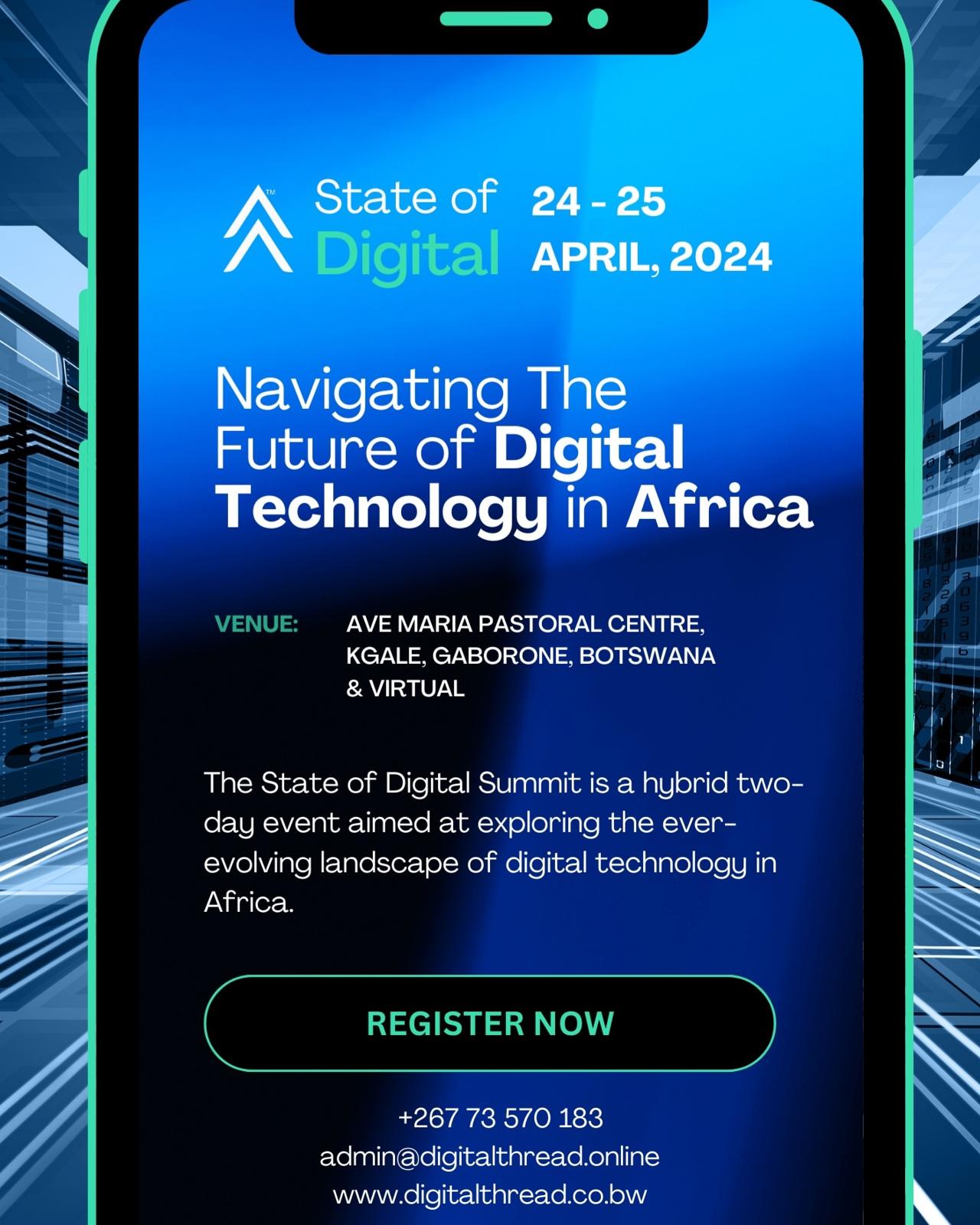 Career Development & Inspiration
State of Digital Summit: navigating the future of digital technology in Africa
Save the Dates: April 24th and 25th, 2024Venue: Ave Maria, Kgale, GaboroneLivestreaming Available for Global Participation
 AVO3 Dec 20231 min read
 Business & Finance
The 5 questions marketers skip before plugging in AI
At the Business and Leadership Expo in Gaborone, Maverick Kabelo asked a room of marketers a question about their AI tools that most of them had never put to themselves.
 Caron Moloi20 Oct 20264 min read